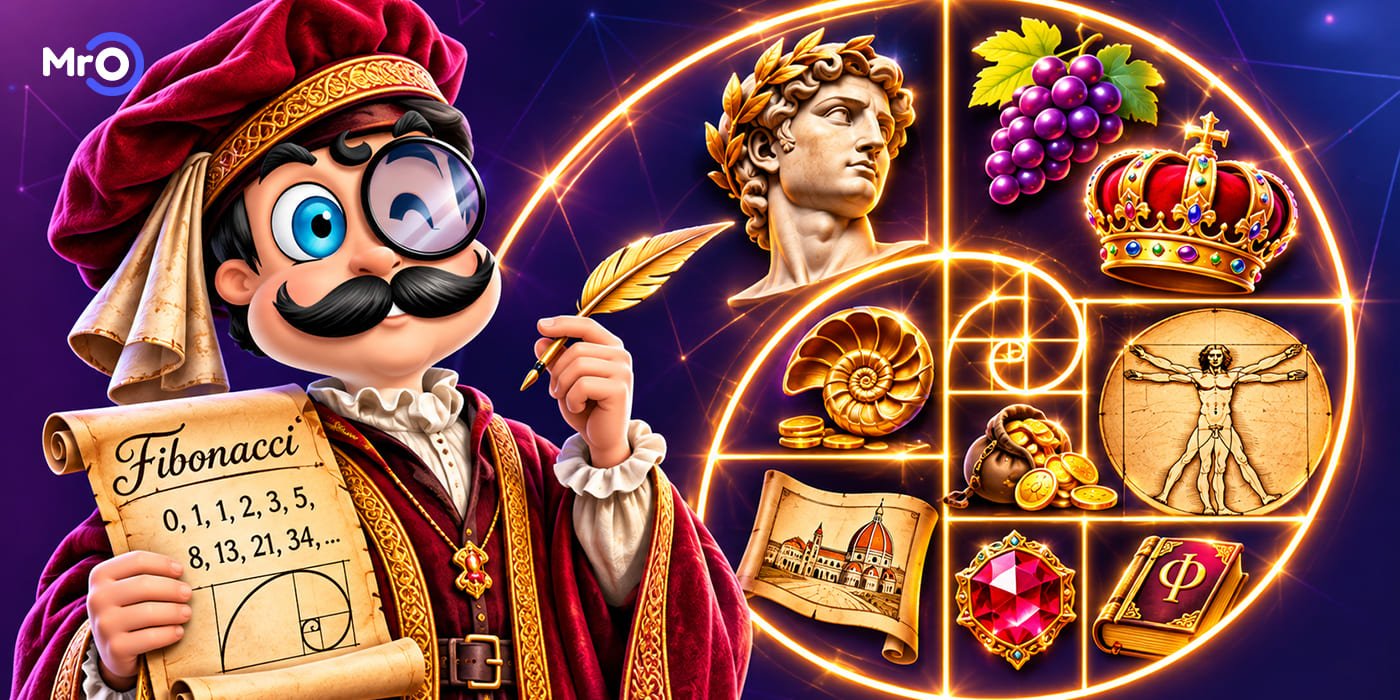
Fibonacci Day: Unlock the Mystery of Numbers and Slots
Whoever said you’d never use math after school clearly never met a casino player with a strategy. And before you run for the hills, yes, we’re talking math – the fun way. No, you won’t need to show your homework. Have you ever heard of Fibonacci? Well, the Fibonacci Day arrives every year on November 23. In the American date format, November 23 appears as 11/23. Those digits create 1, 1, 2, and 3, the opening numbers of the famous Fibonacci sequence. The pattern continues with 5, 8, 13, 21, and 34. Each new number is created by adding the previous two numbers together. Simple, elegant, and surprisingly addictive.
I understand why people enjoy this sequence. Once you notice a clear pattern, you immediately want to discover what comes next. It feels like mathematics has left a trail of breadcrumbs. Slot games can inspire a similar reaction. Repeated symbols, changing multipliers, and visible collections may encourage players to search for a hidden order. However, a beautiful mathematical sequence cannot predict a random result. So, what makes Fibonacci numbers so fascinating, and can they really reveal anything about the next spin?
Why Do We Celebrate Fibonacci Day?
Fibonacci Day honors the Fibonacci sequence and Leonardo of Pisa, the medieval mathematician commonly known as Fibonacci. He introduced the sequence to a wider European audience through Liber Abaci, a mathematical work published in 1202. However, similar number patterns had already appeared in earlier Indian mathematics.
The sequence usually begins like this:
- 1
- 1
- 2
- 3
- 5
- 8
- 13
- 21
- 34
- 55
The rule is wonderfully simple. Add the final two numbers to find the next one. For example:
- 1 + 1 = 2
- 1 + 2 = 3
- 2 + 3 = 5
- 3 + 5 = 8
- 5 + 8 = 13
Therefore, November 23 creates the perfect date for celebrating the sequence. The numbers 1, 1, 2, and 3 are already waiting inside 11/23. It is one of the most memorable mathematical celebrations hidden directly inside the calendar.
Why Fibonacci Day Makes Patterns Feel Powerful
People naturally search for patterns. Patterns help us recognize faces, learn languages, follow music, and understand routines. They can turn complicated information into something easier to remember.
The Fibonacci sequence feels especially satisfying because every number has a clear connection to the numbers before it. Nothing appears without an explanation. That predictability creates a small mental reward. Once you understand the rule, you can confidently identify the next number. Unfortunately, this experience can also affect how people view random games.
A player may see three low results and expect a stronger one next. Alternatively, several losing spins may make a win feel overdue. The sequence looks meaningful. Therefore, the next result must complete it. However, random outcomes do not need to complete a pattern.
The Mr O Casino guide to randomness explains why streaks and clusters can appear without creating a reliable prediction. Our brains may find a pattern. That does not mean the reels agreed to follow it.
Can Fibonacci Numbers Predict Slot Results?
No. Fibonacci numbers cannot predict the next slot result. Online slots use random number generator technology to produce outcomes according to each game’s programmed rules. A previous independent spin does not reveal which symbols will appear next.
Suppose the last five results included awards of 1, 1, 2, 3, and 5 credits. The sequence may look unmistakable. A player could expect eight credits next because eight follows five in the Fibonacci sequence. Still, the next result does not need to continue that pattern. It could produce another small result, a larger award, or no award at all.
The sequence exists in the recorded results. It does not control the next round. This difference matters. Mathematical patterns can describe something that has already happened. However, description is not always prediction. Personally, I think this is where numbers become slightly mischievous. They can look extremely intelligent while telling us absolutely nothing about what comes next.
Fibonacci Day and the Search for Meaning
Randomness often looks less random than people expect. Many players imagine that random results should appear evenly mixed. Repeated symbols, long gaps, or clusters may seem suspicious. Yet, genuine randomness can produce untidy sequences.
Imagine flipping a fair coin several times. A sequence such as heads, tails, heads, tails may look random. Meanwhile, five consecutive heads may appear planned. Both sequences are possible. The same principle applies to independent slot rounds. Several similar results can appear close together without creating a hidden system.
The brain dislikes that uncertainty. Therefore, it may create a story:
- The slot is becoming more generous.
- A feature is getting closer.
- A multiplier is following a pattern.
- A losing streak must end soon.
- A certain symbol appears every fifth spin.
These observations can feel convincing, especially when they contain real numbers. Nevertheless, an accidental pattern does not provide instructions for the next spin.
Does the Golden Ratio Control Slot Design?
The Fibonacci sequence has a famous connection to the golden ratio. As the numbers grow, dividing one Fibonacci number by the previous number produces values that move closer to approximately 1.618.
Artists, architects, designers, and photographers often discuss this ratio because it can create visually appealing proportions. Consequently, players may wonder whether the golden ratio also controls slot layouts or awards.
Some designers may use balanced proportions, spirals, grids, or other mathematical ideas when creating artwork. However, players should not assume that a slot uses the Fibonacci sequence unless its official information says so.
A game may include:
- Five reels
- Eight symbols
- Thirteen paylines
- Twenty-one possible features
Those numbers may resemble the sequence. Still, their appearance does not prove a deliberate Fibonacci system. More importantly, a visually balanced layout cannot predict an outcome. The artwork and interface present the game. Meanwhile, the mathematical model and random number generator determine how it operates. A golden spiral may look impressive around the reels. It still cannot whisper the next result.
What Is a Fibonacci Betting System?
A Fibonacci betting system uses the sequence to change the size of consecutive wagers. A person may begin with one unit and then move through 1, 1, 2, 3, 5, 8, and 13. After a loss, the next wager usually moves one step forward through the sequence. After a win, it typically moves two steps backward.
This system may appear controlled because every increase follows a mathematical rule. However, it does not change the probability of the next independent outcome. It only changes how much is placed at risk.
The amounts also grow quickly. Starting with a single unit may look harmless. Yet, several steps create wagers of 13, 21, 34, and 55 units. A long losing sequence can increase both the required budget and the potential loss.
No progression can remove a game’s mathematical advantage. Likewise, it cannot guarantee that a favorable result will arrive before a spending limit is reached. Therefore, Fibonacci Day should celebrate the sequence, not turn it into a recovery plan.
A Beautiful Pattern Is Not a Winning Strategy
Mathematics can describe probability accurately. However, that does not mean every mathematical system can defeat randomness. A strategy may organize wagers while leaving the underlying probability unchanged.
This creates an important distinction:
- A budget plan controls spending.
- A wagering pattern changes stake sizes.
- A random number generator produces outcomes.
- A mathematical sequence does not connect independent rounds.
The Fibonacci system cannot make a bonus appear. It cannot make a Wild land in the correct position. Also, it cannot guarantee that a multiplier will arrive when the wager becomes larger. Instead, following the sequence may create the impression of progress.
Moving from one number to the next feels purposeful. Therefore, a player may continue longer because abandoning the sequence feels like stopping halfway through a plan. Nevertheless, the game does not know which step the player has reached. The reels are not counting along.
Fibonacci Day and the Gambler’s Fallacy
The gambler’s fallacy is the belief that previous random results make a different outcome more likely next time. For example, a player may believe that a win is due after several losses. Similarly, they may expect a missing symbol to appear because it has been absent for a long time.
The Fibonacci system can strengthen this feeling. As wagers move from 1 to 2, 3, 5, and 8 units, each step may feel closer to an eventual recovery. The growing numbers create the appearance of a developing story.
However, there may be no final chapter. Earlier losses do not improve the next independent result. Increasing the wager only increases the amount exposed to that uncertainty. The Mr O Casino guide to random number generators offers more information about how independent slot outcomes are generated. A sequence can organize numbers perfectly. It cannot persuade randomness to cooperate.
How to Enjoy Number-Themed Slots Responsibly
Number patterns can still make slot games entertaining. Players may enjoy watching multipliers increase, collecting numbered symbols, or following a feature that clearly records progress. These mechanics can create suspense and give the game a recognizable rhythm. However, the information screen should explain how they work.
Before playing, check:
- RTP
- Volatility
- Bet range
- Paylines or winning system
- Feature rules
- Multiplier limits
- Maximum award
- Collection mechanics
Do not assume that an unfinished visual pattern must continue. Also, do not increase the wager because several earlier results appear to form a sequence. Set spending and time limits before opening the game. Then, keep those limits unchanged regardless of the results.
If you notice yourself counting losses instead of enjoying the session, take a break. Mathematics should make Fibonacci Day interesting. It should not make stopping more difficult.
Try This Fibonacci Day Number Challenge
Here is a simple challenge that does not require predicting any reels. Look for Fibonacci numbers during an ordinary day:
- Count flower petals.
- Examine the spiral pattern on a pinecone.
- Look for design layouts divided into balanced sections.
- Find the sequence in music, art, or photography.
- Continue the numbers beyond 55.
The next values are 89, 144, 233, and 377. Once you begin looking, the sequence can appear in surprising places. However, remember that not every group of familiar numbers proves a genuine Fibonacci pattern. Sometimes five, eight, and thirteen appear together by coincidence. That lesson works surprisingly well for slot results too.
Frequently Asked Questions About Fibonacci Day
When Is Fibonacci Day?
Fibonacci Day takes place on November 23. In the American date format, 11/23 contains the first four Fibonacci numbers: 1, 1, 2, and 3.
What Is the Fibonacci Sequence?
It is a number sequence in which each new number equals the sum of the previous two. It commonly begins 1, 1, 2, 3, 5, 8, and 13.
Can Fibonacci Numbers Predict Slot Results?
No. The sequence cannot predict an independent random slot result. Earlier outcomes do not control which symbols will appear next.
Does the Fibonacci Betting System Guarantee Recovery?
No. It increases or decreases wagers according to the sequence, but it cannot guarantee recovery. Several losses can cause the required amounts to grow quickly.
Do Slots Use the Golden Ratio?
Some game artwork may use balanced visual proportions. However, players should not assume that a game uses the golden ratio or Fibonacci sequence unless its official rules confirm it.
Can Number Patterns Make a Win Due?
No. A visible pattern in previous independent results does not make a specific future result due.
How Should I Celebrate Fibonacci Day?
Explore the sequence in mathematics, nature, art, or design. You can also test how quickly you can calculate its next numbers without using a calculator.
Celebrate Fibonacci Day Without Chasing a Formula
Fibonacci Day reminds us that simple rules can create extraordinary patterns. The sequence begins with two small numbers. From there, it grows into something that appears throughout mathematics, design, and discussions about nature.
That is genuinely fascinating. However, admiration should not become prediction. A cluster of symbols may look meaningful. Several results may resemble a sequence. Meanwhile, a progressive wagering system may feel carefully controlled. None of these details can guarantee the next random outcome. Personally, I prefer enjoying the Fibonacci sequence where it behaves properly: inside mathematics. On the reels, numbers have a habit of developing their own personalities.
Explore more guides on the Mr O Casino Blog or visit Mr O Casino to view the available games. Choose games for entertainment, read their rules, and keep every session within clear limits. After all, 1, 1, 2, and 3 may create the perfect date. However, they do not create a promise about the next spin.